
Get Started with glyanno
glyanno.RmdThe Challenge
Mass spectrometry-based glycomics and glycoproteomics often yield data with limited structural resolution. For example, MALDI-TOF MS-based glycomics typically provides only m/z values, while many LC-MS/MS-based glycoproteomics workflows identify basic glycan compositions but lack isomer specificity. Mass spectrometry alone frequently fails to distinguish specific monosaccharide isomers (e.g., differentiating Mannose from Galactose), or resolve linkage details (e.g., a1-3 vs b1-4).
In theory, full structural resolution is achievable by combining MS with orthogonal techniques such as enzymatic digestion or NMR; however, these approaches are often resource-intensive and time-consuming. Unfortunately, advanced downstream analyses—such as the glycan biosynthetic pathway reconstruction offered by glyenzy— require fully resolved glycan structures, including specific monosaccharide identities and linkage information.
What is glyanno?
glyanno bridges this gap. This package is designed to
maximize the utility of your mass spectrometry data by annotating it
with probable biological context derived from knowledge bases. The
package features four core functions:
-
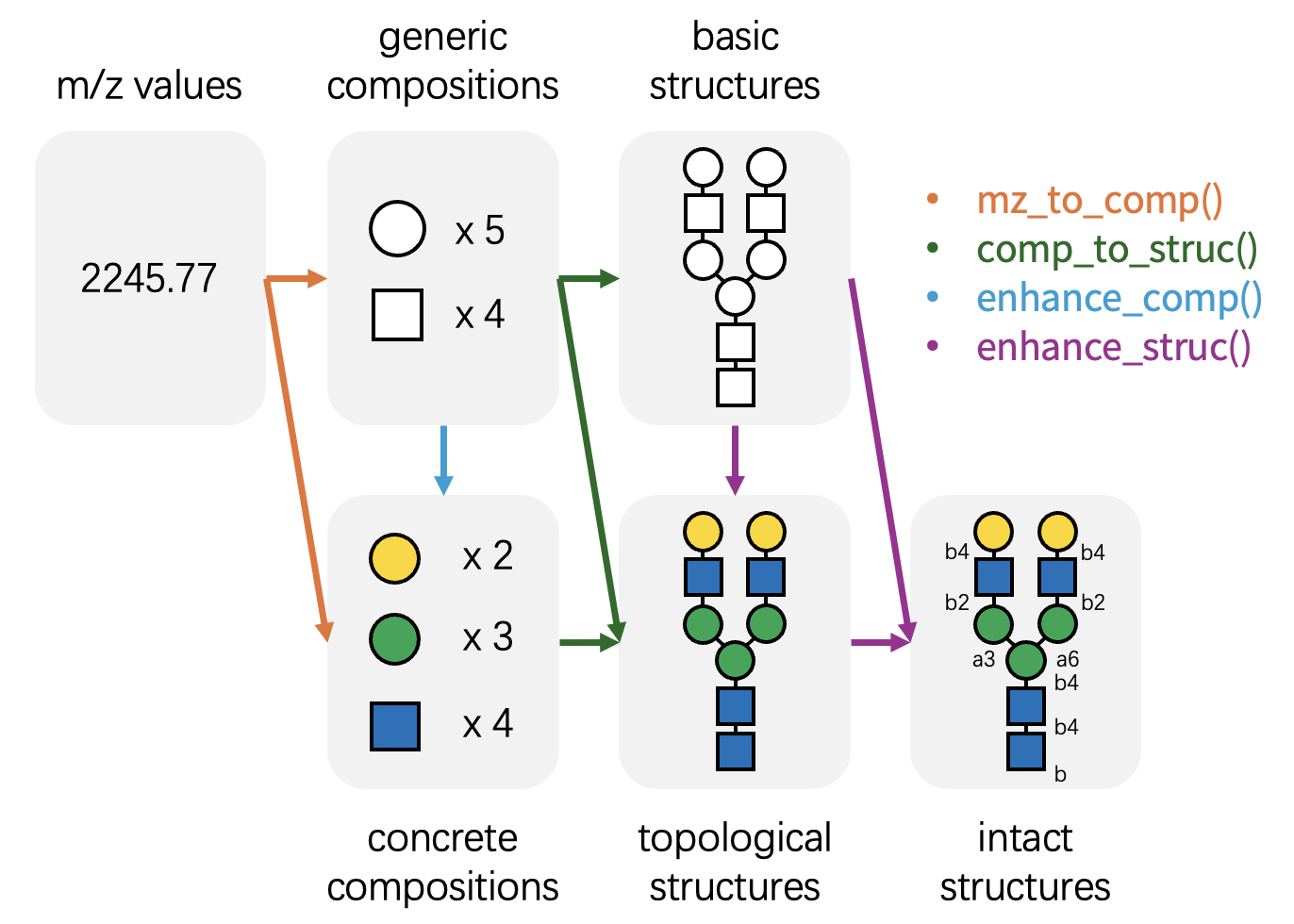
mz_to_comp(): Identifies possible glycan compositions from m/z values. -
comp_to_struc(): Maps glycan compositions to potential glycan structures. -
enhance_comp(): Refines generic glycan compositions into concrete, monosaccharide-specific compositions. -
enhance_struc(): Resolves low-resolution glycan structures into high-resolution structures with linkage information.
library(glyanno)
library(glydb)
#>
#> Attaching package: 'glydb'
#> The following object is masked from 'package:glyanno':
#>
#>     struc_to_glytoucan
Note: This package relies on glyrepr and glydb. We recommend
familiarizing yourself with these packages, especially
glyrepr, before using glyanno. Additionally, a
basic understanding of IUPAC-condensed notation is recommended for this
vignette. You can refer to this tutorial.
Build the annotation cache
After installing or updating glydb, an interactive
library(glyanno) call reminds you to build the persistent
annotation cache:
The build uses the installed glydb data and saves the
result in tools::R_user_dir("glyanno", "cache"), following
the R
Packages guidance on persistent user data. Calling the build
function again reuses the current cache. A changed glydb
version makes the cache outdated and triggers another reminder on
attachment. Annotation still works if you defer building: the needed
views are prepared in memory and discarded when R exits.
The cache contains:
| Data | Used for |
|---|---|
| Concrete and generic composition views | Composition enhancement and mass annotation |
| Four structure views: intact/topological × concrete/generic, including parsed graphs | Composition-to-structure and structure matching; de novo fallback |
| Exact and generic composition lookup groups, residue counts, and confidence ranks | Candidate selection and stable best-match selection |
| Species and glycan-type membership; concrete and generic counts | Database filtering without reprocessing structures |
| Floating-part/substituent flags | Excluding unsupported candidates with the existing warnings |
| Residue masses for six built-in dictionaries and counts for custom dictionaries | Mass annotation across derivatizations, mass types, charges, and adducts |
| Structure keys and GlyTouCan accessions | Local accession lookup |
All views come from glydb’s public getters. Their
candidate order and confidence scores are preserved, including when
filters are combined. Query-specific graph matching is still performed
by glymotif; arbitrary user inputs cannot all be
precalculated. Custom databases supplied through the deprecated
db argument are not written to disk.
Use these commands to inspect, rebuild, or remove the cache:
glyanno_cache_info()
build_glyanno_cache(force = TRUE)
clear_glyanno_cache()
A rebuild writes a complete replacement before replacing the previous file, so an interrupted build preserves the previous cache. After validation, the old file is moved to a temporary backup so replacement also works on Windows. A failed replacement restores that backup; a successful replacement removes it. Only one completed cache is kept. A directory lock prevents simultaneous writers. If a process is killed and leaves a lock, the next build reports the lock’s path for manual removal.
Cache inspection and package attachment read only a small metadata
header and check the file size. The compressed annotation data are
loaded and validated when annotation first needs them, then reused in
the session. If the payload is damaged while its header remains valid,
use build_glyanno_cache(force = TRUE) to repair it. Caches
written in the previous format trigger a rebuild reminder.
For a different storage location, set
options(glyanno.cache_dir = "/your/path") before building
or annotating. The cache also checks the representation and
graph-library versions, R major/minor version, collation locale, and its
internal schema to avoid reusing incompatible objects. Restart R after
updating dependencies. Development changes to glydb data
without a version bump require an explicit rebuild with
force = TRUE.
Workflow: M/z -> Composition -> Structure
Let’s demonstrate these functions step-by-step, starting with a single m/z value.
mz_to_comp(406.1325, charge = 1, adduct = "Na+")
#> # A tibble: 7 × 3
#>      mz composition       confidence
#>   <dbl> <glydb_cm>             <dbl>
#> 1  406. Gal(1)GalNAc(1)        5.32
#> 2  406. Gal(1)GlcNAc(1)        2.71
#> 3  406. Glc(1)GlcNAc(1)        0.693
#> 4  406. Man(1)GlcNAc(1)        2.08
#> 5  406. GalNAc(1)L-Gal(1)     -1
#> 6  406. GalNAc(1)Galf(1)      -1
#> 7  406. GlcNAc(1)Galf(1)      -1
This returns every composition in glydb matching the m/z
of 406.1325. In practice, returning “all” possibilities can be
overwhelming; you will often want to constrain the search space based on
biological context.
The annotation functions accept filters for the built-in
glydb database. For example, you might want to limit the
search to only human O-GalNAc glycans.
mz_to_comp(406.1325, charge = 1, adduct = "Na+", species = "Homo sapiens", glycan_type = "O-GalNAc")
#> # A tibble: 1 × 3
#>      mz composition     confidence
#>   <dbl> <glydb_cm>           <dbl>
#> 1  406. Gal(1)GalNAc(1)       5.32
The results are now significantly more relevant to our specific context.
With the composition identified, we can proceed to determine potential structures. The m/z value 406.1325 corresponds to the composition Gal(1)GalNAc(1). What are the possible structures for this composition?
comp_to_struc("Gal(1)GalNAc(1)", species = "Homo sapiens", glycan_type = "O-GalNAc")
#> # A tibble: 3 × 3
#>   composition     structure           confidence
#>   <comp>          <glydb_st>               <dbl>
#> 1 Gal(1)GalNAc(1) Gal(b1-3)GalNAc(a1-       5.32
#> 2 Gal(1)GalNAc(1) Gal(b1-3)GalNAc(b1-       1.10
#> 3 Gal(1)GalNAc(1) Gal(a1-3)GalNAc(a1-       1.61
comp_to_struc() selects structures from
glydb using the same filters.
Two structures are possible, one is Core 1, the other is Core 5.
Sometimes we just want a “most possible” result. In this case, you can
set return_best to TRUE:
comp_to_struc("Gal(1)GalNAc(1)", species = "Homo sapiens", glycan_type = "O-GalNAc", return_best = TRUE)
#> <glydb_structure[1]>
#> [1] Gal(b1-3)GalNAc(a1-
#> # Unique structures: 1
Core 1 is more common than Core 5, so it was kept. The function keeps the structure with most citations for multiple matches.
Note that when return_best = TRUE, the function returns
a vector with the same length of the input instead of a tibble. When a
glycan has no matches, <NA> will be on the
corresponding position.
Note that all functions in glyanno works
vectorizedly:
comp_to_struc(c("Gal(1)GalNAc(1)", "GlcNAc(1)GalNAc(1)"), species = "Homo sapiens", glycan_type = "O-GalNAc", return_best = TRUE)
#> <glydb_structure[2]>
#> [1] Gal(b1-3)GalNAc(a1-
#> [2] GlcNAc(b1-3)GalNAc(a1-
#> # Unique structures: 2
If you set return_best to TRUE, the
function directly returns a vector:
comp_to_struc(c("Gal(1)GalNAc(1)", "GlcNAc(1)GalNAc(1)"), species = "Homo sapiens", glycan_type = "O-GalNAc", return_best = TRUE)
#> <glydb_structure[2]>
#> [1] Gal(b1-3)GalNAc(a1-
#> [2] GlcNAc(b1-3)GalNAc(a1-
#> # Unique structures: 2
This vector always has the same length as the input, with
NA for glycans with no match.
You can also set the structure level used for matching. For example, it is possible to use a database with only topology-level structures without linkage information.
comp_to_struc(
  c("Gal(1)GalNAc(1)", "GlcNAc(1)GalNAc(1)"),
  structure_level = "topological",
  species = "Homo sapiens",
  glycan_type = "O-GalNAc"
)
#> # A tibble: 4 × 3
#>   composition        structure                 confidence
#>   <comp>             <glydb_st>                     <dbl>
#> 1 Gal(1)GalNAc(1)    Gal(??-?)GalNAc(??-             5.32
#> 2 Gal(1)GalNAc(1)    Gal(??-?)GalNAc-ol(??-          3.22
#> 3 GlcNAc(1)GalNAc(1) GlcNAc(??-?)GalNAc(??-          2.77
#> 4 GlcNAc(1)GalNAc(1) GlcNAc(??-?)GalNAc-ol(??-       2.40
Enhancing Compositions and Structures
Researchers often need to refine generic annotations into more
specific ones. For instance, you may wish to convert generic
compositions into specific monosaccharide lists, or assign potential
linkages to a topology-only structure. enhance_comp() and
enhance_struc() are designed for this purpose.
Both functions return a tibble with two columns: raw
(the original input) and enhanced (the potential
high-resolution candidates).
enhance_comp("Hex(1)HexNAc(1)")
#> # A tibble: 7 × 3
#>   raw             enhanced          confidence
#>   <comp>          <glydb_cm>             <dbl>
#> 1 Hex(1)HexNAc(1) Gal(1)GalNAc(1)        5.32
#> 2 Hex(1)HexNAc(1) Gal(1)GlcNAc(1)        2.71
#> 3 Hex(1)HexNAc(1) Glc(1)GlcNAc(1)        0.693
#> 4 Hex(1)HexNAc(1) Man(1)GlcNAc(1)        2.08
#> 5 Hex(1)HexNAc(1) GalNAc(1)L-Gal(1)     -1
#> 6 Hex(1)HexNAc(1) GalNAc(1)Galf(1)      -1
#> 7 Hex(1)HexNAc(1) GlcNAc(1)Galf(1)      -1
enhance_struc("Gal(??-?)GalNAc(??-")
#> # A tibble: 9 × 3
#>   raw                 enhanced            confidence
#>   <struct>            <glydb_st>               <dbl>
#> 1 Gal(??-?)GalNAc(??- Gal(b1-3)GalNAc(a1-       5.32
#> 2 Gal(??-?)GalNAc(??- Gal(a1-3)GalNAc(b1-      -1
#> 3 Gal(??-?)GalNAc(??- Gal(b1-3)GalNAc(b1-       1.10
#> 4 Gal(??-?)GalNAc(??- Gal(b1-4)GalNAc(b1-      -1
#> 5 Gal(??-?)GalNAc(??- Gal(a1-6)GalNAc(a1-      -1
#> 6 Gal(??-?)GalNAc(??- Gal(b1-6)GalNAc(a1-      -1
#> 7 Gal(??-?)GalNAc(??- Gal(b1-6)GalNAc(b1-      -1
#> 8 Gal(??-?)GalNAc(??- Gal(a1-3)GalNAc(a1-       1.61
#> 9 Gal(??-?)GalNAc(??- Gal(b1-4)GalNAc(a1-      -1
Similarly, filters narrow down results to biologically relevant candidates.
enhance_comp("Hex(1)HexNAc(1)", species = "Homo sapiens", glycan_type = "O-GalNAc")
#> # A tibble: 1 × 3
#>   raw             enhanced        confidence
#>   <comp>          <glydb_cm>           <dbl>
#> 1 Hex(1)HexNAc(1) Gal(1)GalNAc(1)       5.32
enhance_struc("Gal(??-?)GalNAc(??-", species = "Homo sapiens", glycan_type = "O-GalNAc")
#> # A tibble: 3 × 3
#>   raw                 enhanced            confidence
#>   <struct>            <glydb_st>               <dbl>
#> 1 Gal(??-?)GalNAc(??- Gal(b1-3)GalNAc(a1-       5.32
#> 2 Gal(??-?)GalNAc(??- Gal(b1-3)GalNAc(b1-       1.10
#> 3 Gal(??-?)GalNAc(??- Gal(a1-3)GalNAc(a1-       1.61
You can set return_best to TRUE as
well.
enhance_struc(
  "Gal(??-?)GalNAc(??-",
  species = "Homo sapiens",
  glycan_type = "O-GalNAc",
  return_best = TRUE
)
#> <glycan_structure[1]>
#> [1] Gal(b1-3)GalNAc(a1-
#> # Unique structures: 1
De novo enhancement of N-glycans
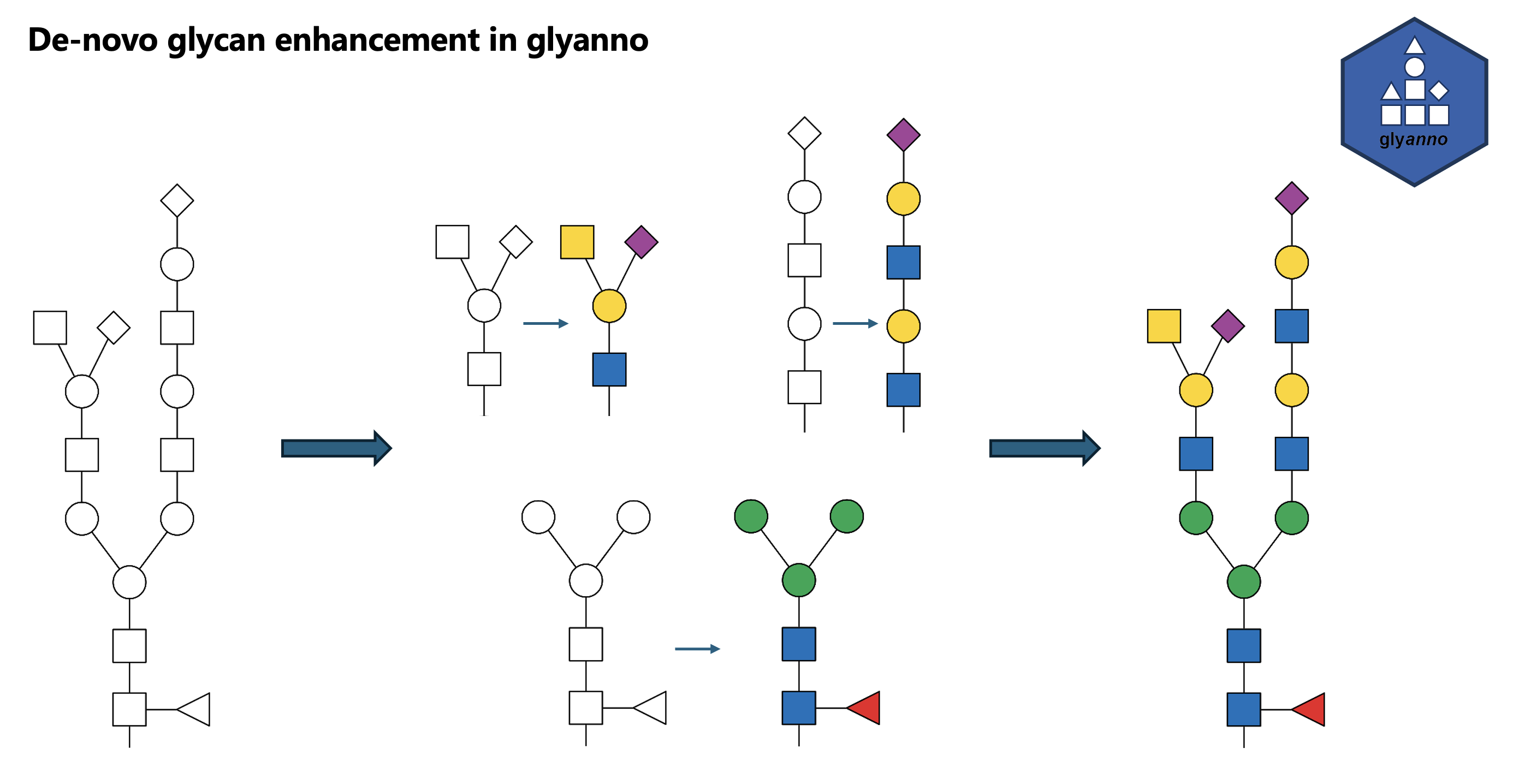
N-glycans have many possible branching patterns, but databases of
human- detected glycans cover only a fraction of this potential
structure space. enhance_struc_denovo() reconstructs
generic topological N-glycans from their conserved core and branches,
returning one concrete topological candidate per input. It preserves
optional core fucose and bisecting GlcNAc residues. Inputs that cannot
be reconstructed are matched against a topological fallback
database.
glycan <- "NeuAc(??-?)Hex(??-?)HexNAc(??-?)Hex(??-?)HexNAc(??-?)Hex(??-?)[HexNAc(??-?)[NeuAc(??-?)]Hex(??-?)HexNAc(??-?)Hex(??-?)]Hex(??-?)HexNAc(??-?)[dHex(??-?)]HexNAc(??-"
enhance_struc_denovo(glycan)
#> <glycan_structure[1]>
#> [1] Neu5Ac(??-?)Gal(??-?)GlcNAc(??-?)Gal(??-?)GlcNAc(??-?)Man(??-?)[Neu5Ac(??-?)[GalNAc(??-?)]Gal(??-?)GlcNAc(??-?)Man(??-?)]Man(??-?)GlcNAc(??-?)[Fuc(??-?)]GlcNAc(??-
#> # Unique structures: 1
All non-missing inputs to enhance_struc_denovo() must
contain only generic residues and must be topological. Missing values
are allowed and preserved.
Bidirectional Conversion
While glyanno focuses on inferring high-resolution
information from low-resolution data, the glycoverse
ecosystem also provides complementary functions to perform the reverse
operations—simplifying detailed structures back to their
lower-resolution representations.
A summary of these relationships: